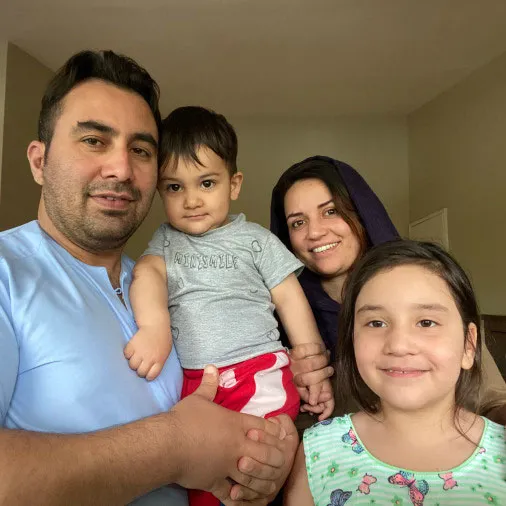
The Story of One Afghan Family: World Refugee Day 2020
This story was written for the Lutheran Social Services Newsletter by LSSNCA Community Outreach Director, Dana Lea. It has been shortened and edited for publication on the GNCH website.
Mohammad Wais Formuly arrived in the U.S. during March, in the midst of the coronavirus pandemic. In Afghanistan, Formuly had been a professor of political science and international relations. Unfortunately, when many refugees and immigrants arrive in the U.S., their degrees and certifications must be verified or recertified to resume the same career field. This is the situation for Formuly and he is exploring education options for achieving his U.S. certification. Formuly agreed to share some of his background because he understands these stories help American supporters better comprehend the circumstances which has forced refugee and immigrants to flee their homes. His family's story may also help develop a deeper compassion in our U.S. communities to more fully embrace refugees and immigrants.
Formuly said: “We moved to the United States with the wish to become productive citizens and not only to serve this country but also to become able to help Afghanistan and the world one day. Therefore, I wanted to tell them that we, as immigrants, are interested to talk to them, know about them, and exchange ideas with them. To settle in this country, we want to learn from one another and become citizens of this country. We, as newly arrived immigrants, need their social and psychological supports to adapt in this country and not to feel being separated from our native country.”
Mohammad Wais Formuly, a 34 year old man from Kabul in Afghanistan, earned a business degree and later a bachelors in political science and masters in international relations from Khatam al-Nabin University. He has worked with a media group, a youth housing project coordinator, and as a finance officer in a literacy project of the Afghanistan National Security Force (ANSF), as well as a professor in higher education. Most recently, Formuly was a professor of political science and international relations at the University of Kardan. He has written articles and been published several times.
Formuly’s wife is quite impressive, as well. She has two degrees in Law and Dari Literature. In Afghanistan, she was working as a teacher in a private high school. They have two children and their daughter is interested in becoming a lawyer like her mother. Both their daughter and two-year old son like to play soccer and watch cartoons.
Many of the decisions Formuly has made in life, including coming to the U.S., he considered in the best interest of his wife and children. His hopes for life in the U.S. include living in a country and community “free from any kinds of discrimination and inequalities. Just like American families, I want my wife, my son, my daughter, myself (and other immigrants) to have all the opportunities and facilities to grow and develop in order to become productive citizens of the United States and for the world.”
“I hope that the school my son and daughter will be attending will help my children to realize their full potential, skills and talents so that they become able to find their academic career and life interests and paths. I also hope my children may be able to serve the United States and their motherland Afghanistan in the best possible way. In addition, I hope my wife and I also be will able to accomplish our career and educational goals, however, we feel this might be somewhat difficult during the initial stages.”
Although, Formuly says he loves his mother country greatly and was happy with his career, he chose to move his family to the U.S. to find a more peaceful place to live. His decision was made based on four major reasons:
- He was largely tired of seeing his country in a prolonged 40 years of war;
- The lack of personal, social, legal, political, and economic security in Afghanistan;
- The existence of terrorist groups at large;
- His belief that everyone has a right to live a peaceful life.
Therefore he applied for a Special Immigrant Visa (SIV), which would allow his entire immediate family to move to the U.S. The SIV application process was complex, costly, and time consuming but after 5 years, his family was granted the visas.
Formuly obtained the SIV because of his work with ANSF Literacy project which was funded by the U.S. government and NATO. It was designed to educate Afghan Security Forces with the basics of education. "The program promoted education, mutual understanding and peace in country. But we all know that the extremist groups will never tolerate such initiatives and developments in my homeland – Afghanistan. Therefore, these extremist groups have always strived to target and murder employees of such programs ...and their family members. As a result of being employed with the US-Government project, life threatening risks were created for me and for my family.”
Leaving Afghanistan was a disruption in his career and life plans, but Formuly keeps a positive outlook. “I had a sense of fulfillment and accomplishment when I was able to teach the young generation and taking part in the development of my country. I moved to the U.S. with the same intention to get a PhD in political science and to serve back the U.S., Afghanistan, and other countries through my knowledge and expertise. Although I am very hopeful and optimistic about my move to the U.S., I feel a little bit of a challenge. I realized that I have to start everything from the beginning here."
Before moving to the U.S., Formuly’s thought the U.S. was the most “hegemonic country in the world in the areas of politics, economy, security, and culture at the international level." He thought, “The U.S. has been able to provide all positive facilities and opportunities of life for its citizens and shape its cultural structure in such way that no gender, religious, racial, economic, social, linguistic and other differences are more valued, but all Americans are equal and all have equal rights.”
He has largely found his expectations to be true, despite encountering a few challenges: high cost of living, little value given to immigrants’educational background and work experiences, and large differences in culture and social life. (Of course, the Formuly family did happen to move to the U.S. in the middle of the COVID-19 pandemic causing further issues in the job hunt and social isolation.)
Despite these challenges, the hurdles his family jumped over to get to the U.S., and worries over family members who remain in Afghanistan, Formuly has hope. “For my family and me, it will take some time to adapt to a new culture, a new country, diverse people, and a new system to start pursuing our goals.”
To discover ways that you can support and welcome refugees and SIV holders in the DMV, look at info in our website for Becoming Involved! Household and furniture donations are needed for us to welcome new families into a home, we have multiple volunteer opportunities and financial assistance is vital to our work as a non-profit. Thank you for standing with refugees and with GNCH!
Share this: